
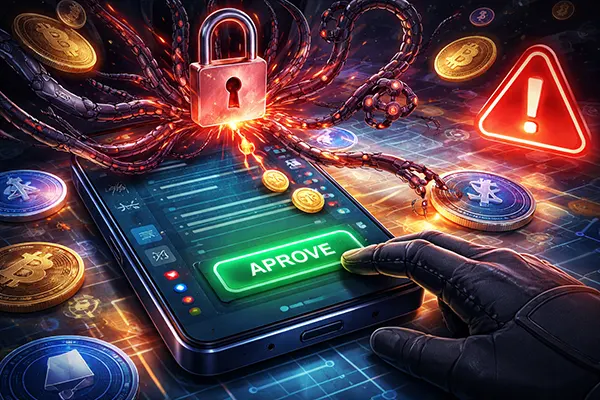
Dangerous Token Approvals: How Unlimited Permissions Expose Your Funds
Token approvals are a standard part of interacting with decentralised applications, yet they remain one of the most underestimated security risks in crypto. Many users grant permissions without fully understanding what they allow, especially when approvals are set to unlimited amounts. In 2026, as DeFi and Web3 ecosystems continue to grow, attacks exploiting excessive approvals remain a leading cause of asset loss. Understanding how these permissions work and how they can be abused is essential for anyone managing digital assets.
What Token Approvals Are and Why They Exist
When interacting with decentralised exchanges, lending protocols or NFT marketplaces, users must first approve a smart contract to access their tokens. This approval acts as permission for the contract to spend tokens on the user’s behalf. Without it, basic actions such as swapping or staking would not be possible.
In most cases, wallets offer two options: approve a specific amount or grant an unlimited allowance. The second option is often selected because it removes the need to repeat approvals for future transactions. While convenient, this approach significantly increases exposure if the contract is compromised or behaves maliciously.
Technically, approvals are recorded on-chain using functions like approve() in ERC-20 tokens. Once granted, they remain active until manually revoked. Many users are unaware that approvals persist indefinitely, even if they stop using the application.
How Unlimited Allowances Become a Security Risk
Unlimited approvals mean that a smart contract can transfer any amount of tokens from the user’s wallet without further confirmation. If the contract contains vulnerabilities or is later exploited, attackers can drain funds instantly without additional interaction.
Another common risk arises from phishing. Fake interfaces mimic legitimate services and trick users into approving malicious contracts. Once approval is granted, attackers can execute transfers at any time, often without immediate detection.
In 2026, several high-profile exploits have demonstrated that even reputable protocols can become attack vectors. When contracts are upgraded or dependencies change, previously safe approvals may become unsafe, creating hidden risks for long-term users.
Real Attack Scenarios Linked to Token Approvals
One of the most frequent attack patterns involves compromised smart contracts. A protocol may be secure at launch, but later vulnerabilities allow attackers to take control. If users have granted unlimited approvals, funds can be extracted without any new transaction being signed.
Another scenario includes malicious token contracts. Some tokens are designed with hidden logic that interacts with approvals in unexpected ways. When users approve these tokens, they unknowingly expose other assets within their wallet.
There are also cases where front-end interfaces are hacked. Even if the underlying contract is secure, a manipulated interface can request approvals to a different address. Users relying solely on familiar branding often miss these subtle changes.
Why Revoking Access Is Often Overlooked
Many users assume that closing a website or removing a token from their wallet cancels permissions. In reality, approvals remain active on the blockchain until explicitly revoked. This misunderstanding leads to long-term exposure across multiple protocols.
Tools for managing approvals exist, but they are not always integrated into everyday workflows. As a result, users rarely review or clean up old permissions, especially if they interact with multiple services over time.
Gas fees have historically discouraged frequent revocation, although improvements in scaling solutions have reduced this barrier. Despite lower costs in 2026, user behaviour has not fully adapted, leaving many wallets with unnecessary active approvals.

Best Practices to Reduce Approval-Related Risks
The most effective approach is to avoid unlimited approvals whenever possible. Approving only the required amount limits potential damage if something goes wrong. While it may require more frequent confirmations, the trade-off is significantly improved security.
Regularly reviewing active approvals is another essential habit. Dedicated tools allow users to inspect which contracts have access to their tokens and revoke permissions that are no longer needed. This should be part of routine wallet maintenance.
Using separate wallets for different activities can also reduce risk. For example, keeping long-term holdings in a wallet that never interacts with smart contracts prevents exposure through approvals entirely.
How to Identify Suspicious Approval Requests
Before confirming any approval, it is important to check the contract address and ensure it matches the official source. Blindly trusting interfaces increases the risk of interacting with malicious contracts.
Unusually high approval amounts or requests that appear unrelated to the intended action should raise concern. If a simple token swap requires full wallet access, this is a clear warning sign that something may be wrong.
Staying informed about recent exploits and known vulnerabilities also helps reduce risk. Many attacks follow predictable patterns, and awareness allows users to recognise threats before they result in financial loss.
Similar articles
-
Dangerous Token Approvals: How Unlimited Permis...
Token approvals are a standard part of interacting with decentralised …
-
 ZK-KYC Without Excessive Data Disclosure: Can Z...
Identity verification remains one of the most sensitive and contested …
-
 Shuffle Casino Fairness Review: How to Read Bon...
Shuffle Casino has become widely discussed among players who use …
-
 Deposit and withdrawals via L2 / Lightning: whe...
By 2026, second-layer crypto infrastructure has matured significantly, yet the …